

Which Event Helped Draw European Immigrants To Brazil In The 1720s?
| Total population | |
|---|---|
| 91,051,646 47.73% of Brazilians identify as existence white [1] | |
| Regions with significant populations | |
| Entire country; highest percents found in southern states and southeast states | |
| Languages | |
| Portuguese minorities speak assorted German language dialects, mainly Riograndenser Hunsrückisch, Talian and Polish. Other smaller minorities include Ukrainian, Dutch, Lithuanian, Russian, Yiddish | |
| Religion | |
| Roman Catholicism, Protestantism, Faithlessness, Atheism, Spiritism, Jehovah Witnesses, Mormonism, Orthodoxy, Judaism, Buddhism and Japanese new religions |
European immigration to Brazil refers to the movement of European people to Brazil. It should not exist confused with the colonisation of the country by the Portuguese.
History [edit]
Maria Stella Ferreira Levy[2] suggests the following periodisation of the process of immigration to Brazil:
- 1. 1820-1876: pocket-sized number of immigrants (about half dozen,000 per yr), predominance of Portuguese (45.73%), with significant numbers of Germans (12.97%);
- 2. 1877-1903: big number of immigrants (well-nigh 71,000 per year), predominance of Italians (58.49%);
- 3. 1904-1930: big number of immigrants (about 79,000 per twelvemonth), predominance of the Portuguese (36.97%);
- iv. 1931-1963: declining number of immigrants (about 33,500 per yr), predominance of the Portuguese (38.45%).
During the first 2 periods, immigration to Brazil was almost exclusively of European origin, and information technology remained the majority during all four, in spite of the increasing importance of Japanese clearing.
Offset period: 1820-1872 [edit]
Immigration properly started with the opening of the Brazilian ports, in 1808. The government began to stimulate the arrival of Europeans to occupy plots of land and become minor farmers. Subsequently independence from Portugal, the Brazilian Empire focused on the occupation of the provinces of Southern Brazil.[3] From 1824, immigrants from Primal Europe started to populate what is nowadays the region of São Leopoldo, in the province of Rio Grande practise Sul. Clearing stalled in 1830, due to legislation forbidding authorities spending with the settlement of immigrants. Besides, Rio Grande practise Sul, the main target of clearing, was convulsed with civil war from 1835 to 1845.[four]
Between 1820 and 1871, 350,117 immigrants entered Brazil. Of these, 45.73% were Portuguese, 35.74% of "other nationalities," 12.97% Germans, while Italians and Castilian together did non accomplish six%. The total number of immigrants per year averaged half-dozen,000.[5] Portuguese immigrants generally were sought after for the cities as they were established in commerce and peddling; others, particularly the Germans, were brought to settle in rural communities as small-scale landowners. They received country, seed, livestock and other items to develop.

Second Period: 1872-1903 [edit]
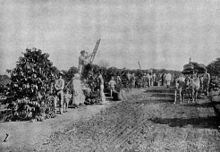
In the concluding quarter of the 19th century, the entry of immigrants in Brazil grew strongly. On 1 manus, Europe underwent a serious demographic crisis, which resulted in increased immigration; on the other hand, the terminal crunch of Brazilian slavery prompted Brazilian government to find solutions for the problem of work force. Consequently, while immigration until 1872 was focused on establishing communities of landowners, during this period, while this older process continued, immigrants were more and more than attracted to the coffee plantations of São Paulo, where they became employees or were allowed to cultivate small tracts of land in exchange for their work in the coffee ingather.[3]
During this period, immigration was much more intense: big numbers of Europeans, peculiarly Italians, ane.1 meg (of a total of most 2 million from 1870 to 1940), were brought to the state to work in the harvest of coffee, their travel beingness paid by Brazilian government.[vi] 1872 to 1903, virtually two meg immigrants arrived, at a charge per unit of 71,000 per year[7]
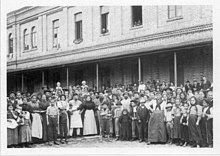
Italian immigrants in the Hospedaria dos Imigrantes, in São Paulo.
By the offset of the 1870s, the alternative of the interprovincial slave trade was exhausted, while the demand for workforce in the coffee plantations continued to expand. Thus the paulista oligarchy sought to concenter new workers from abroad, past passing provincial legislation and pressing the Purple government to organise immigration.[viii] [nine] Tensions arose between the governmental bureaucracy, that was concerned in populating the country with immigrants accounted easily adaptable to Brazilian civilization and compatible with the racial prejudices of the time, and the coffee planters, eager for inexpensive labour force of whatever origin; government concerns predominated while Italian and Spanish immigration was sufficient to see the demand, but as early on as 1892 pressure from the planters forced the government to abandon restrictions against Asian immigrants, although a serious crisis in the java civilisation by the end of the century postponed whatever applied initiatives concerning this until 1908.
Third period: 1904-1930 [edit]
From 1904 to 1930, 2,142,781 immigrants came to Brazil - making an annual average of 79,000 people. In event of the Prinetti Decree of 1902, that forbade subsidised emigration to Brazil, Italian immigration had, at this stage, a drastic reduction: their average almanac entries from 1887 to 1903 was 58,000. In this menses they were just 19,000 annually. Every bit a consequence, immigration of non-Europeans was organised, with Japanese immigrants arriving from 1908 on. The Portuguese constituted 38% of entries, followed by Spaniards with 22% and Germans. From 1914 to 1918, due to World War I, the entry of immigrants of all nationalities decreased.[5] Afterwards the War, the immigration of people of "other nationalities" redressed quicklier than that of Portuguese, Spaniards, Germans and Italians. Part of this category was composed of immigrants from Poland, Russia and Romania - whose emigration was prompted by the collapse of the Russian and Austrian-Hungarian Empires in the aftermath of the First Globe War - but function by non-Europeans, mainly Syrian and Lebanese people. Both subgroups included a number of Jewish immigrants, who arrived in the 1920s. Overall, European immigration remained clearly majoritary during the menses, though Japanese clearing grew, and attempts to restrict clearing to Europeans, on racist bases, in 1921 and 1923, were defeated in the Brazilian Congress; however, attempts to organise Black American immigration to Brazil also failed due to authoritative action past the Brazilian consulates in the United States, that systematically denied visa to Black applicants, on confidential orders by the Brazilian Foreign Affairs Ministry.[10]
4th Menstruation: 1931-1964 [edit]
From 1931 to 1963, ane,106,404 immigrants entered Brazil, at an almanac rate of 33,500. The participation of Europeans decreased, while that of Japanese increased. From 1932 to 1935 immigrants from Nihon constituted 30% of total admissions.[5]
With the radicalisation of the political state of affairs in Europe, the finish of the demographic crunch, the decadence of coffee civilization, the Revolution of 1930 and the consistent rise of a nationalist government, clearing to Brazil was significantly reduced. The Portuguese remained the well-nigh significant group, with 39.35%.[5]
Immigration too became a more urban miracle; most immigrants came for the cities, and even the descendants of the immigrants of the previous periods were moving intensely from the countryside. In the 1950s, Brazil started a program of immigration to provide workers for Brazilian industries. In São Paulo, for example, betwixt 1957 and 1961, more than than 30% of the Spanish, over 50% of the Italian and 70% of the Greek immigrants were brought to piece of work in factories.
The role of European immigration in the transition from slave labour to wage labour [edit]


Group of Italians arriving in São Paulo.
There seems to be no easy explanation of why slaves were non employed as wage workers at the abolition of slavery. Ane possibility is the influence of race-based ideas from the second half of the 19th century and early 20th century, which were based in the pseudo-scientific belief of the superiority of the "White race". On the other hand, Brazilian latifundiaries had been using slave manpower for centuries, with no complaints about the quality of this workforce, and there were non important changes in Brazilian economic system or piece of work processes that could justify such sudden preoccupation with the "race" of the labourers. Their embracing of those new, racist, ideas, moreover, proved quite flexible, even opportunist: with the irksome down of Italian immigration since 1902 and the Prinetti Decree, Japanese clearing started in 1908, with any qualms most their non-Whiteness existence quickly forgotten.
An of import, and ordinarily ignored, part of this equation was the political situation in Brazil, during the terminal crisis of slavery. Co-ordinate to Petrônio Domingues, by 1887 the slave struggles pointed to a real possibility of widespread insurrection[ citation needed ]. It was as a response to such situation that, on May 13, 1888, slavery was abolished, equally a ways to restore order and the command of the ruling class, in a situation in which the slave system was almost completely disorganised.
Another factor, also commonly neglected, is the fact that, regardless of the racial notions of the Brazilian elite, European populations were emigrating in neat numbers - to the United States, to Argentina, to Uruguay - which African populations certainly weren't doing, at that time. In this respect, what was new in "immigration to Brazil" was not the "immigration", but the "to Brazil" part. As Wilson practise Nascimento Barbosa puts it,
-
- The collapse of slavery was the economic result of three conjugated movements: a) the end of the kickoff industrial revolution (1760-1840) and the beginning of the so-chosen 2d industrial revolution (1880-1920); b) the lowering of the reproduction costs of the White homo in Europe (1760-1860), due to the sanitary and pharmacological impact of the outset industrial revolution; c) the raising costs of African Blackness slaves, due to the increasing reproduction costs of Black men in Africa. [ citation needed ]
Slavery was abolished past police (Lei Áurea, signed by Regent Princess Isabel) on 13 May 1888.[11]
The influence of racist pseudo-scientific ideologies, so prevalent amongst the educated elites in the Western World, may have acquired the Brazilian government to believe that the Brazilian national identity could only exist built in the base of operations of European clearing. All the same, other factors were possibly at piece of work here, such as the necessity of bringing permanent immigrants (avoiding a phenomenon like to the golondrina migration to Argentina was certainly a concern[ citation needed ]), implying the necessity of bringing immigrant families instead of alone individuals, and considerations nearly linguistic communication, faith, and other cultural bug. However, these regime positions were never unopposed amidst the ruling landed course, which frequently pressed for a more lax policy on immigration, particularly when there was labour shortage.
The Lei Áurea set up off a reaction amid slave owners, which contributed to the erosion of the political foundations of the monarchy. After a few months of parliamentary crises, the Emperor was deposed by the military on November fifteen, 1889, and a Republican regime established.
Notable people [edit]


References [edit]
- ^ "Censo Demográfi co 2022 Características da população e dos domicílios Resultados do universo" (PDF). eight November 2022. Retrieved 2014-07-12 .
- ^ [1] Maria Stella Ferreira Levy. O papel da migração internacional na evolução da população brasileira (1872 a 1972) p. 52.
- ^ a b O papel da migração internacional na evolução da população brasileira (1872 a 1972)
- ^ [2] Maria Stella Ferreira Levy. O papel da migração internacional na evolução da população brasileira (1872 a 1972)] p.51.
- ^ a b c d Entrada de estrangeiros no Brasil
- ^ Eliane Yambanis Obersteiner. Café atrai imigrante europeu para o Brasil - 22 February 2005 - Resumos | História do Brasil
- ^ Maria Stella Ferreira Levy [3]. p.51
- ^ [abep.nepo.unicamp.br]
- ^ Start of the immigration to Brazil
- ^ Thomas Skidmore. Racial ideas and social policies in Brazil, 1870-1940. In Richard Graham et al. The Idea of race in Latin America, 1870-1940 p. 23-25.
- ^ "www.soleis.adv.br -- Divulgue este site".
- ^ http://revistaepoca.globo.com/Revista/Epoca/0,,EDG75727-6009,00-DILMAA+PODEROSA.html
- ^ "Tiago Splitter's Jewish roots revealed". 15 February 2007.
- ^ http://world wide web.messaggerosantantonio.information technology/messaggero_emi/pagina_articolo.asp?IDX=810IDRX=136 [ dead link ]
- ^ Janotti 1990, p. 17. sfn fault: no target: CITEREFJanotti1990 (aid)
- ^ http://world wide web.dw.de/lya-luft-a-cultura-alemã-me-influenciou-muito/a-1437528
- ^ See: Schwarcz 1998, p. 47 harvnb mistake: no target: CITEREFSchwarcz1998 (help), Barman 1999, p. i harvnb mistake: no target: CITEREFBarman1999 (help), Besouchet 1993, p. 41 harvnb fault: no target: CITEREFBesouchet1993 (assist).
- ^ http://www2.uol.com.br/fernandamontenegro/english language/bio.htm [ dead link ]
- ^ "Morena Baccarin". IMDb.
- ^ http://exame.abril.com.br/revista-exame/edicoes/0950/noticias/jovem-bilionario-trapaceiro-492991
- ^ "Mari - UOL Esporte - Pan 2007".
- ^ "Archived copy". Archived from the original on 2022-12-21. Retrieved 2014-12-22 .
{{cite web}}: CS1 maint: archived copy as title (link) - ^ "Individual Site".
- ^ Nascido no bairro operário da Mooca, em São Paulo – filho do vendedor de frutas calabrês Francisco Serra Archived 2008-10-06 at the Wayback Machine
- ^ http://www.dw.de/gisele-bündchen-brazil-should-become-world-champion/a-2029705
- ^ Cielo surname is Italian
- ^ Scolari is the grandson of an Italian immigrant and since he has been in Europe he has practical for Italian citizenship and visited Veneto, where his grandfather Luigi Scolari was born
- ^ "Daniela Mercury | Biography & History". AllMusic.
- ^ "Made to last | Architects of change".
Encounter also [edit]
- European clearing to Argentina

Source: https://en.wikipedia.org/wiki/European_immigration_to_Brazil
Posted by: burkswhispectilly.blogspot.com
0 Response to "Which Event Helped Draw European Immigrants To Brazil In The 1720s?"
Post a Comment